
All about Master Copies
And why YOU should do one!

Recently I sat down and created what is known in the art world as a “Master Copy” of an illustration I have long admired and had saved to my Pinterest illustrations board. I loved everything about it- the subject matter (of a rather saucy looking Marie Antoinette, drawn from a screengrab of the 2006 Marie Antoinette film), the colour palette, the dreamy shapes and wonderfully rendered skin and composition. It embodies everything that I try and make my commercial illustrative work look.
So, I decided to make a Master Copy, and it turned out rather good, in my opinion.
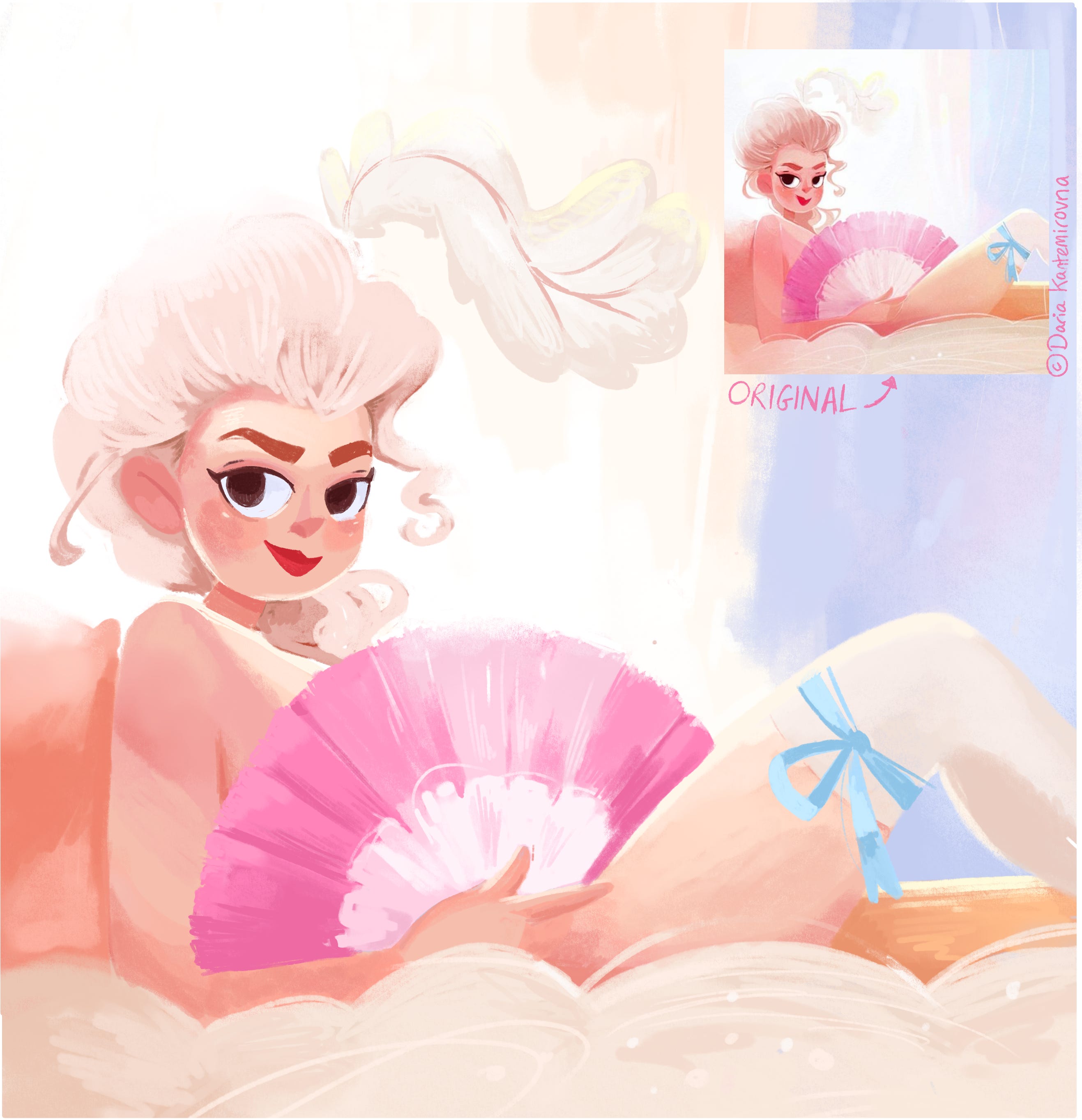
Image: Master Copy of an Illustration by Daria Kantemirovna (Insta: https://www.instagram.com/daria.kantemirova/)
Original image © Daria Kantemirovna
So, what is a Master Copy anyway?
A Master Copy is a well-established art learning technique used by artists all through the history of art. Most famously, master copies were employed heavily in the renaissance period. They were used to teach apprentices in the artist’s studio, where the young student would copy out the master’s drawings and compositions under tight conditions. They would observe the drawing, study it carefully, in order to dissect it and see the complex workings underneath, and copy it out.
A famous example is Jacopo “Tintoretto” Robusti copying out Michelangelo’s never fully executed sculpture “Samson and the Philistines”, a fantastic study on how one Italian master learns directly from another.


Gallery: (Left) Tintoretto’s studies of Michelangelo’s model of never fully completed sculpture “Samson and The Philistines” (Right)
Image credits:
https://artuk.org/discover/artworks/studies-after-michelangelos-samson-and-the-philistines-334908
https://www.wikiart.org/en/michelangelo/samson-and-two-philistines
Put simply, a Master Copy is a study of another artwork where the work is reproduced. The image still belongs to the original artist, and is being used as a learning tool.
Why Do a Master Copy?
So many reasons, and why stop at one? I say create as many master copies as you can. The works of artists before us hold lessons and secrets that merely observing is not enough. Only by taking the time and walking in that artist’s shoes, piece by piece, bit by bit, will you begin to truly understand how the original work has been calculated and put together. Using the lessons you glean from working on master copies, you can then apply to your own future artworks.
I refer you to a brilliant video by Proko on just this subject, on how you can develop your style by studying the greats:
Isn’t copying bad, though?
We’re taught from school age that copying is a bad thing. We’re taught not to copy our peers, to work on our own things. As we grow older, we are further discouraged from copying and claiming artworks as our own. This is absolutely right, and feeds into my personal feelings about learning algorithms and A.I generated images. However, a master copy, ethically executed, is not just copying.
In some artistic circles, the “All copying is bad” is repeated, and it is mainly beginner artists who bear the brunt of this and can find themselves being discouraged from studies and references. I would argue however that as artists, we build upon and stand on the shoulders of those who have come before us. We pass knowledge and craft on to each other like a multigenerational game of Pass the Parcel. Study and copy regularly and often. Make notes and question why and how at every opportunity. Work with intent. Study the same piece from different angles, in different mediums.
The golden rule I would argue however, is to never copy an artwork and claim it as your own. Credit the original artist.
How to make an effective Master Copy
Okay, so we’ve come to the conclusion that making master copies is an effective learning tool and you can’t wait to make one of your own. I’ve made a list of points to follow when making your own study to refer to in order to maximise your learning potential:
🔸 Do it respectfully and fully credit the original artist! If working from an old master, credit the source where you found the image. DO NOT CLAIM THE FINAL AS YOUR OWN.
🔸️ If working Digitally, no colour picking! Try and work from eye and colour match as close as you can. Note where these colours fall on the colour wheel and why they work harmoniously.
🔸️ Same with drawing! Try and draw the original image yourself from eye. Use a grid if it helps.
🔸️ Make notes on how you can translate the skills you are learning into your own art. How is the artist you are studying using line, colour, blending modes, paint strokes etc?
🔸How can you use the techniques you have learned in your own pieces? Experiment and play with these techniques- you might find a new way of working!
And finally, what I feel is most important (aside from respect)
🔸️Choose artwork that inspires you that carries the kind of vibe and properties that you want your art to have!
I hope that you enjoyed today’s Newsletter with The Shoreline. I’m hoping to post one of these newsletters Monthly, so if you like what you read here, please feel free to follow me!
Have a wonderful day!